
According to J. Paul Getty, the author of HOW TO BE RICH and historic billionaire American industrialist, there are four types of individuals, especially when it comes to employment.1 These types of individuals can be found across any corporation or growing organization. For the sake of this essay, we will label these four types as such:
Type A: This group consists of, “individuals who work best when they work entirely for themselves – when they own and operate their own business. Such men do not want to be employed by anyone.” This level of autonomy in a corporation is only offered to “key” employees.
Type B: This group consists of. “[individuals] who, for any of a large number of reasons, do not want to go into business for themselves, but who achieve the best , and sometimes spectacular, results when they are employed by others and share in the profits of the business.” This group has great potential within a corporation and are typically rewarded well for their results.
Type C: This group consists of, “individuals who want only to be salaried employees, people who are reluctant to take risks and who work best when they are employed by others and enjoy the security of a steady salary.” This would make up the majority of a corporations workforce in present day. Some of these individuals can make great contributions to an organization or company, but those contributions could go unnoticed, unclaimed (claimed by someone else), and, unfortunately, unrewarded.
Type D: This group consists of, “[individuals] who work for others but have the same attitude toward their employers that postal clerks have towards the Post Office Department…they are not motivated by any need or desire to produce a profit for their employer.” This group is typically unhappy and reluctant to take actions that align with the best interest for an organization. They are really just there for the paycheck and can be a negative influence to others in an organization due to their level of pessimism. Needless to say, their engagement is very low to non-existent.
In his book, The Fourth Economy, Ron Davison begins to explore what the future of the corporation could look like and, if the entrepreneurial economy gets a strong foothold, probably will have to look like in order to compete to retain top talent. The vastness of opportunities for entrepreneurs in present day is tremendous compared to the opportunities even 10 to 15 years ago, and it dwarfs the opportunities that were present 50 years ago. There are several reasons for this. We have far more industries and markets today and we are creating more markets everyday.2 The cost of capital to start a business is lower than it has ever been before and for some pursuits is astronomically lower. There are more and easier ways to network, build communities, or reach customers from around the globe. There is more information that is either free, or very affordable, to teach you whatever you might need to know to undertake any project or experiment than there has ever been in the history of mankind. All of this opportunity, and the probability that it will become even more abundant and even easier to obtain in the years to come, could lure away top talent from corporations as these individuals pursue their own dreams and desires.
In present day, the corporation’s employee composition looks like this:
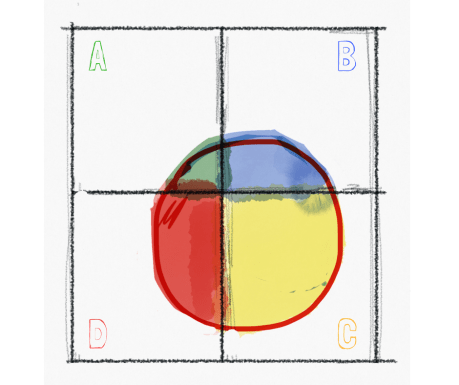
Each quadrant, designated by employee type, represents the environment in which that type of employee operates in, and the colorful blob represents the makeup of employees in current day corporations. You can see the majority of employees either fall into Type C or Type D employment, while much fewer fall into Type A or Type B employment. We could spend a considerable amount of time exploring why this composition exists (and maybe we’ll explore that in a future post), but for whatever reasons, this is how the corporate employment cookie has crumbled.
We have discussed the employment personality types of each group, but now let’s find out how corporations tend to view/treat/reward each group:
Type A: Given full autonomy*, full flexibility*, abundant resources for development/advancement, abundant opportunities, massive earnings/wealth potential. These are your C-suite level employees, some upper management, as well as highly regarded individual contributors like top level sales executives. They can move around the organization easier, are able to work on projects they find more fulfilling, have the ability to pursue opportunities for development or take long sabbaticals, and can participate in very generous compensation plans.
*Depending on the type of company, whether it is public or private, there could be some limitations. I.e the CEO of a public corporation still needs to answer to the board of directors and shareholders.
Type B: Given increased autonomy, increased flexibility, increased resources for development/advancement, more opportunities, increased earnings/wealth potential. Most of upper management, fast risers currently in middle management, and some individual contributors fall into this category. Very similar to Type A, but limited to an extent. They might not always get put on the project they want to work on, but the project that a Type A believes would benefit them or the organization more. Still have great opportunities for development, but are not participating in the best compensation plans just yet.
Type C: Given limited autonomy, limited flexibility, limited resources for development/advancement, fewer opportunities, limited earnings/wealth potential. Most of middle and lower management, as well as individual contributors who mostly likely have been deemed unsuitable for management roles but meet performance expectations fall into this category. These individuals still have some flexibility, but are very limited in their ability to pursue projects or opportunities they find fulfilling. Their destiny in an organization is somewhat out of their hands based on previous and current performance measures. They make up a majority of the organization and are critical for day-to-day operation, but are also less likely to consistently drive value for an organization.
Type D: No autonomy, no flexibility, little to no resources for development/advancement, little to no opportunities, little earnings potential and little to no wealth potential. Some lower management and the rest of the individual contributors who most likely struggle to consistently meet performance expectations fall into this category. These individuals are typically on some type of performance improvement plan.
In the future, the corporation’s employee composition would need to start trending to look like this:

The employee composition rotated on the point marked (x), thus the play on words used for the title of this essay.
There are a few observations to note from this new composition, among others, that further explain this new model. The colorful blob did shrink, which does imply that Corporations will shrink. This is 1) partly due to reducing headcount in type D employees (caused by SaaS and hopefully migration into type C status) and 2) as type B rotate into type A, some will inevitably leave to create their own businesses and bring along some of their trusted type B’s and C’s. These are not necessarily bad things because as more individuals become entrepreneurial, more businesses will be created and more employment opportunities should arise for any Type D’s or C’s that find themselves unemployed. The key for Type D’s and Type C’s is then to find a way to start working with the Type B and Type A mindsets. Another takeaway is that Type B’s should start to make up the majority of the employee composition. This means that more employees start getting the opportunities to develop and be rewarded for their actual contributions.
Now, it is important to note that Blockchain technology could have a drastic effect on the corporations of the future. A lot of what I have been reading about blockchain, as it pertains to corporations, mentions that it has the ability to create “flat” hierarchies. What we see mostly present day, and for basically all of the 20th and early 21st centuries, are hierarchies structured like a pyramid. Where your Type D employees and Type C employees would roll up under Type B employees, and Type B employees would roll up under Type A employees. I am not really certain as to how the flat hierarchy will actually look, and it could depend on industry or field as to how flat the hierarchy will get.3 I suppose the greatest potential for blockchain is that it will reward for actual value, production, and results that can at times be hard to identify for particular individuals and remove a lot of the politicking involved with modern day “climbing the corporate ladder.” You would hopefully see a lot more employees fall into Type A and Type B categories with the only limit to their growth being set by themselves.
Regardless of the inevitable change to corporations that will be brought on by blockchain, modern day corporation are still operating in an outdated model. Leaders of these organizations will need to be forward looking in order to survive the transition into the Entrepreneurial Economy. Adopting a system that will allow more employees to operate in the Type B quadrant would not only help the individual employees have a more meaningful and successful career, but would also benefit the organization itself as their human capital which is behind the innovation that drives profit, starts to finally be incentivized appropriately.
- In Paul Getty’s own words, “…led me to believe that most men fall into four general categories.” In the context of his writings, he was talking about men and their outlook on employment.
- By this I am implying the phenomenon of niche markets as well as actual new markets. Niche Markets are more of a subset of a pre-existing market, but with needs that have not been fully met. Identifying these niche markets and being able to provide the products and services they desire is easier and more cost efficient than it has ever been before. I like to think of niche markets as a new vendor setting up in a pre-existing market square. This new vendor is able to attract buyers in the market square who never were really able to have their needs met by pre-existing vendors set up in the market square, or were able to attract new buyers to that market square. New markets would actually be providing a product or service that has never been provided before or completely changing the paradigm of an existing market. This would be like opening up a new market square, or completely renovating a pre-existing market square to the point where the vendors would have to completely change the way they do business. A real life example would be Amazon. They have been able to completely change the way several industries do business.
- I think any field or industry that is heavy in tech, development, or project management would go towards a flatter hierarchy, whereas something like manufacturing or construction might still resemble somewhat of a pyramid. This is only a hypothesis based on my limited knowledge of blockchain though 🙂 This is definitely a topic that will be discussed in future posts.
 System Tinker