*This is part one of The Diseconomies of Scale Series which takes a deeper look into why bigger is not always better.
The Communication Problem
Exchanges of information (EOI) are imperative within any organization or social interaction. EOIs benefit greatly from a one-on-one (1-o-1) communication channel (CC). This is a direct connection between two individuals. There is no need to go through anyone else to communicate. This helps with speed and as we will see further down, accuracy. EOIs benefit even greater from a trusted and contextually understood 1-o-1 CC.
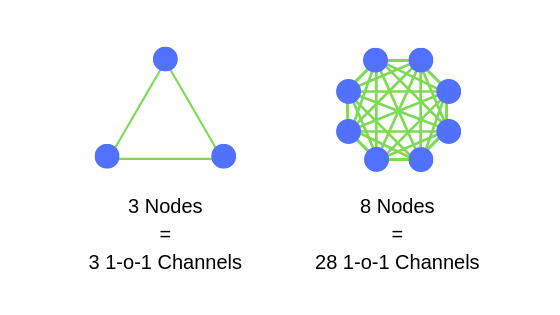
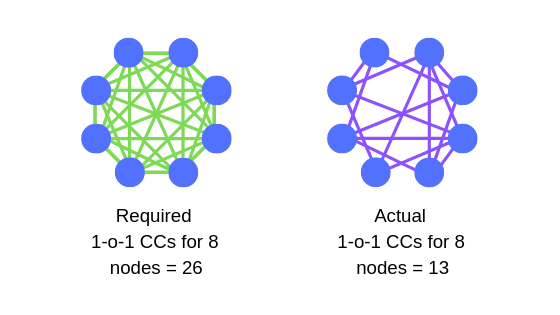
This diagram shows what 1-o-1 CCs look like in an organization of 3 nodes and 8 nodes. You can see that as the nodes start to increase, so does the amount of possible 1-o-1 CCs at a nonlinear rate. So what is happening here?
The required 1-o-1 CCs for an organization is equal to:
(n(n-1)) / 2
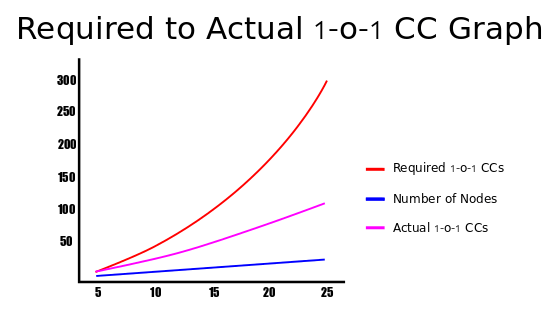
Where n equals the number of communicating nodes in an organization. Traditionally, communicating nodes would be people, but today, it includes software systems as well. So an organization with 3 nodes requires only 3 1-o-1 CCs, whereas an organization with 25 nodes requires 300 1-o-1 CCs. This mathematical relationship results in the exponential growth of required 1-o-1 CCs and poses the problem. The diagram below illustrates this exponential growth relationship.
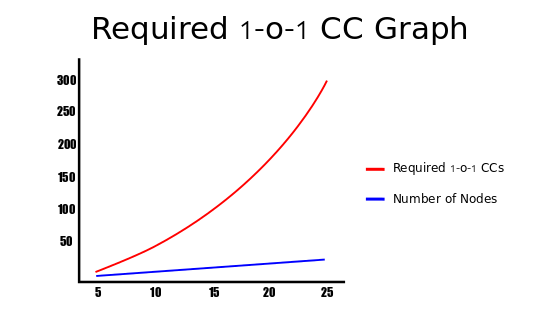
The more the 1-o-1 CCs requirement grows, the less likely 1-o-1 CCs will actually occur. This is mainly due to individual capacity constraints. This results in the increasing length of the communication path between two nodes trying to communicate. There will most likely be a few-to-many nodes along those communication paths whether it is due to having to communicate through hierarchical structures or through rerouting initiatives. Communicating through a hierarchal structure is when individuals have to communicate through their hierarchy (up/down the chain). This is amplified when a message needs to be communicated across (horizontally) the organization, but must first be communicated through the hierarchy (vertically). Communicating through rerouting is when individuals communicate with the wrong individual/s and the message must now be rerouted to hopefully the correct individual. So why does this become a problem?
The Telephone Game
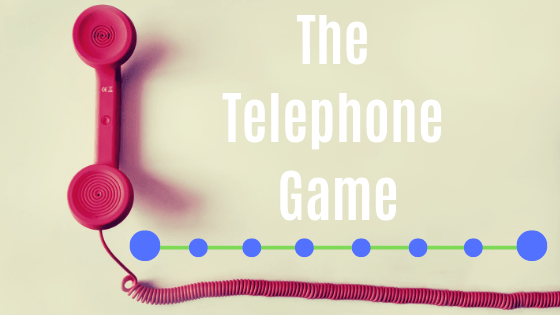
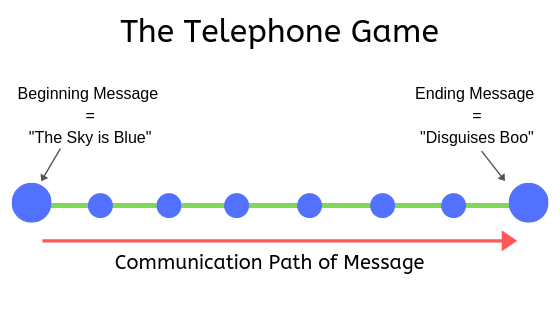
Here is a simple game to play (one that we all probably learned about in grade school) to illustrate the resulting side effects: the telephone game.
The telephone game is played by having individuals, organized in a line, communicate a message from one end of the line to the other end on a one by one basis typically whispering the message (so no other node can hear) in each others ear as it passes along. The beginning message is compared to the end message for accuracy. The usual result is that the messages differ by a varying degree. Causes of this variability include (but are not limited to) cognitive biases (such as anchoring bias, priming effect, and perception bias), signal/noise representation errors, emotional interference, and even malicious intent. So simply put, EOIs can suffer greatly. Without proper and/or important information being communicated, the organization is more likely to make bad decisions based on incomplete or inaccurate data.
Actual CCs, Degree of Connectivity, Reachability, and Shortest Path
As mentioned before, due to capacity constraints, an organization is less likely to meet its required 1-o-1 CCs as it grows. The number that we need to work with is the Actual CCs. The Actual CCs represent the total number of communication channels established within an organization.
Actual CC would realistically start to have a decreasing rate of correlation between itself and the Required 1-o-1 CC figure as it starts to grow at a slower rate.
The Degree of Connectivity is a measure specific to the individuals nodes. It is the measure of the number of connections the node has to other nodes.
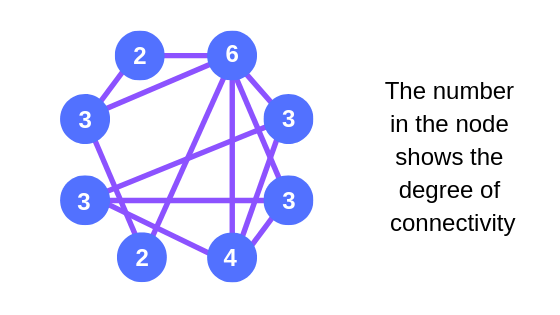
This degree of connectivity can be thought of in terms of the immediate likelihood of a node being involved with(relaying or hearing) a message that is communicated through an organization. If there is a lack of a reasonable amount of actual 1-o-1 CCs within an organization, having more nodes with high degrees of connectivity would benefit the organization. The more nodes with higher degrees of connectivity, the less likely negative outcomes of the telephone game will occur. This is because it helps with creating shorter paths, reducing the amount of intermediary nodes needed to communicate a message. The Shortest Path refers to minimum number of CCs that must be used to get a message from one to another. In the diagram directly above, some nodes don’t require any intermediary nodes to communicate a message to another, but some would require up to 2 intermediary nodes to communicate a message to another. Ultimately, it helps nodes with lower degrees of connectivity improve their reachability. Reachability refers to the ability of a message (with intent intact) to get from one node to another within an organization.
Measuring the Strength of your Organization’s Communication Channels.
The following is a quick, but relatively weak, measure of your organization’s CCs strength. It is weak because it does not factor in a lot of the other components that improve reachability within your organization, but it does at least allow you to set a baseline for improvement. Take your Actual CCs and divide them by your Required CCs:
ACTUAL CCs / REQUIRED CCs
The closer you are to 0, the worse off your organization would be so improvements should continuously be made to move towards 1. I must reiterate that this is a weak measure. You would fare much better by focusing on creating higher degrees of connectivity amongst the individuals within your organization.
Software Systems
Software has played an increasingly more important role in any modern organization. It has reduced the number of individuals needed and has helped streamline processes, but it also poses issues of its own. One of the original points I made was that EOIs benefit even greater from a trusted and contextually understood 1-o-1 CC. Although software in most organizations can be a trusted source of information, it lacks in providing contextual signals that could be of importance. It’s good at producing standardized data and messages, but struggles with anything that is nonstandard or nuanced in nature. So even if software or other technology seems to allow you to improve reachability of every node, the original message intent could be adversely affected by software’s shortcomings.
Takeaways
I believe the Communication Problem is one of the biggest contributors to diseconomies of scale. It is a major root cause for all of the other reasons that lead to diseconomies of scale. The modern organization’s lifeblood is good information. Once the quality of information starts to deteriorate, your organization will start to suffer. Capital will start to be misallocated, mission and purpose will start to become unaligned throughout the organization, and bad decisions will be made. Unfortunately for those who would like to believe that anything can scale without consequences, the math and our biology doesn’t lie. That doesn’t mean we cannot do anything about it.
From an individual level, you can always spend some time understanding how you would need to communicate a message for it to reach its intended receiver with the original intent still intact. Would it matter if it was sent via email and possibly through several other individuals, or does it require direct 1-o-1 contact? You can also work on increasing your degree of connectivity within any organization. It makes you more valuable and should improve your productivity and performance.
From an organizational level, being aware of the communication problem is step one. Look to find ways to increase the amount of nodes who have high degrees of connectivity in your organization. Then, find the ones who do and reward them, specifically the ones who are good at relaying messages with their intention still intact. In the end, you might just need to scale down to become more sustainable.

 System Tinker
4 thoughts on “The Telephone Game & The Communication Problem”