

*This is part two of The Diseconomies of Scale Series which takes a deeper look into why bigger is not always better.
Duplicative efforts are another reason larger organizations or institutions start to see diseconomies of scale. I believe it’s more of a symptom of the communication problem that we discussed in a previous post. In brief, the communication problem showed us why, as organization scale up, direct communication channels become increasingly impossible to keep on a one-on-one basis. Therefore, a breakdown in communication becomes increasingly likely which allows for the opportunity of duplicative efforts to arise. But what are duplicative efforts? This is essentially the same work being performed by multiple individuals or systems in an organization therefore wasting resources and energy without benefiting from any additional output or value creation.
There are very few reasons for duplicative efforts to be warranted and in most cases many people make the mistake of rationalizing it with necessity when in fact it’s just merely preference. For example, reports that a manager would prefer to see a different way (aka their way) when a preexisting report already provides the information they need. They might request someone on their team prepare a similar report but with the view/layout/format they prefer. In this example, two reports are created. They contain the same data and will provide no additional value(output) than if only one report was created, but they come at twice the cost(input).
For any organization or institution there is a purpose for their existence and that is to produce some type of output. Wether it be a product or service, this purpose can only be fulfilled through work. As companies scale, the communication problem intensifies increasing their actual complexity due to information needing to be communicated through more nodes. In order to manage the complexity of this work, we impose some form of order or structure to the organization.
Now there are several ways that an organization can structure themselves around work but a common way is through hierarchy and through departments/functions. Most modern organizations have adopted a hierarchal structure. The departmentalization and work structured through hierarchy, although intended to organize and create efficiencies, also introduces new barriers within the organization. One of these barriers is unnecessary elimination of communication channels. Work becomes less driven through self organization and more through the structured organization.
As a quick side note, like previously mentioned, there are reasons why duplicative efforts make sense. The two main reasons why duplicative efforts are warranted: Training and Transitioning.
- For training, sometimes the best way for people to learn or understand a business or process is through doing the work themselves. This is perfectly fine and can help contribute to the long term success of any organization as long as a deep understanding of the work occurs.
- When transitioning work, sometimes the best approach is to have the two or more parties in the transition run parallel to each other for quality control.
- Both of these reason must remain temporary in nature. They are short term inefficient, but long term efficient necessities.
Once work becomes structured, there are several things of note that happen to the communication channel graph we explored in the communication problem post.
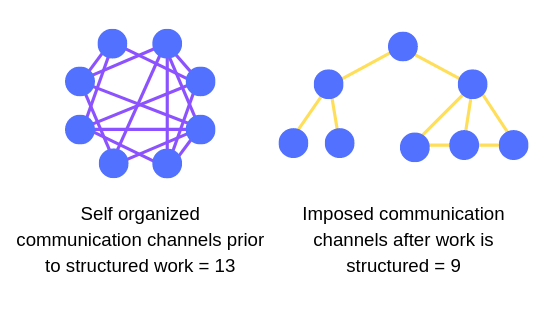
First, there is the removal of some one-on-one communication channels that could naturally occur. It’s important to note that we are specifically referring to communication channels related to work and not any other types of relationships. You can easily chit-chat with someone outside of your direct hierarchy at work, but try to work with them together on your own pet projects, without your managers’ approval, and see how far you get. We limit the ability for self-organization when work becomes structured. This also exacerbates the problem of not having the ideal one-on-one communication channel requirements. Actuals channels are even lower than they would have been in a self organizing fashion.
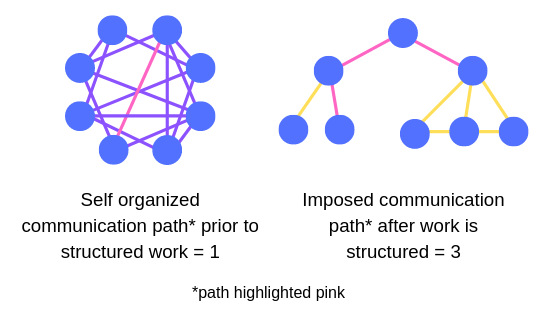
Second, there is an increase to communication paths. What could have been possibly communicated through only one channel, is now communicated through two or more. Longer communication paths are less preferable to shorter paths. The telephone game discussed in the communication problem post highlights why this is. It is much more likely that information becomes distorted during its travel.
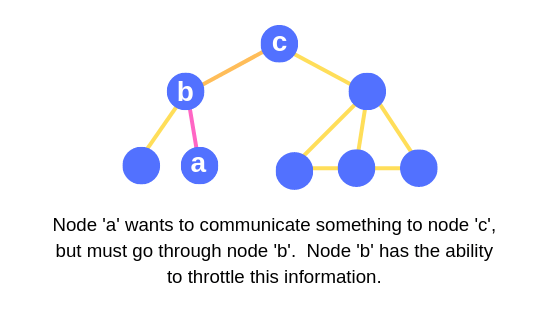
Third, these structured communication paths also introduce the ability for information throttling. Information throttling is when a node is able to control the flow of information that channels through it. They can alter, delay, or stop the information going to its intended recipient. Thus, structured work can ultimately limit the free exchange of information.
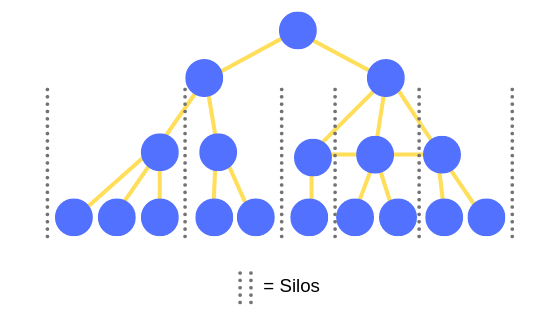
What really can enable duplicative efforts in a structured environment is when these hierarchies start functioning in what are referred to as silos. Silos occur when departments or functions limit or stop information being exchanged between them. Silos are created for a number of reasons: by design, through competing incentives, an attempt to cover up department mistakes, differences of opinions between departments/functions, or even department/function leaders who simply don’t like each other. These silos introduce the increased likelihood that information is not shared across the organization. Data, reports, processes, or even tools are inevitably duplicated. These silos create systematic information throttling. Silos can also create an environment where there are multiple organizations within the overall organization. This is not good because it can cause scenarios where the organization becomes unaligned within itself.
In summary, as organizations scale up, their underlying complexity grows. Their complexity grows because information is the source of success for any organization and that information must be communicated throughout it as efficiently and effectively as possible. The increase in the number of nodes decreases the ability for their to be the ideal one-on-one communication channel between all nodes. In an attempt to reduce this new “complexity”, some form of structure is imposed across the organization. This structure might help at first, but ultimately it introduces its own complexity as well. It further reduces the actual one-on-one communication channels within an organization. It introduces a system mechanism we refer to as information throttling into the organization that limits the ability to freely exchange information. This structure and information throttling also enables the formation of silos within the organization. Once there are silos, there is inevitably duplicative work and tasks being performed within each one. The chance of identifying these duplicative efforts also decreases as communication is limited or prevented between them. Thus you reach the point where the production of goods or services are coming at an increased per-unit cost.
 System Tinker
One thought on “Duplicative Efforts Through Structured Work”