
Work is a necessity of life. Work is the physical or mental effort or activity directed toward the production or accomplishment of something. The resources we need for basic survival and above (especially for anything considered non-necessity leisurely enjoyment) are not naturally abundant. There is work (and sometimes a lot of it) required to obtain these resources to sustain life and to enjoy it.
For purposes of this post, we will be using the term task in place of work. A task is a specific piece of work that has an expected result. I.e. Send your boss last weeks sales figures is a task. As is making a sale, paying a vendor invoice, cleaning your bathroom, or folding the laundry!
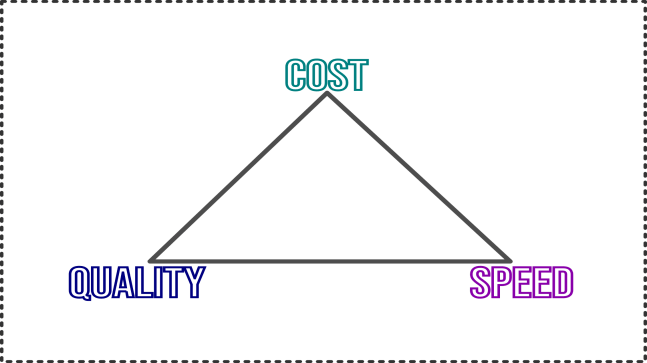
The basic triangle surrounding a task consists of:
- Speed – how long it takes to complete. The goal is as quickly as possible.
- Quality – how good/accurate/usable the results of the task. The goal is highest quality.
- Cost – how much resource (physical/mental labor, natural resources/energy, financial capital) was expended. The goal is as inexpensive as possible.
Everyone would like to have all three: the task was done fast with high quality and didn’t cost much, but just like most things that seem too good to be true, there’s a catch in the form of a trade-off. The trade-off works in the following manner:
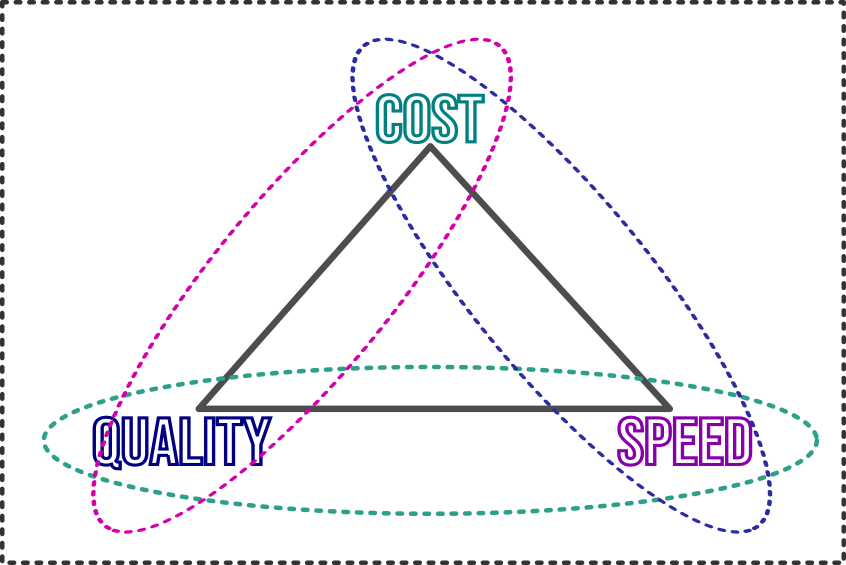
You can only select two of the corners while having to sacrifice the remaining corner.
For example:
- You can have something done fast and done with quality, but it’s going to be expensive.
- You can have something done fast and cheaply, but it probably won’t be great quality.
- You can have something done cheaply and still be quality, but it’s going to take much longer.
It is very important to understand these trade-offs, especially when you are directing or delegating work to other people. Not understanding these trade-offs primarily leads to results such as:
- Employee burnout (employee being asked to do too much in too little time, with little to no support)
- Cost overruns (initial effort is wasted effort because the results were low quality and not useful, causing unnecessary redo’s)
- Missed deadlines (the task had an unreasonable timeline)
Naturally there are built in constraints to consider which actually might aid in your decision making:
For speed, the ultimate constraint is a deadline. Some tasks have a builtin deadline. The quicker the deadline, the more likely you will need to incur costs(by bringing in additional headcount or systems that automate) to have quality results. Or you might want to assign the task to higher skillset individuals.
For cost, the ultimate constraint is funding. If you have limited funding, the more time you will need to allow your folks to work through the tasks requirements to be able to provide quality results.
For quality, the ultimate constraint is availability of skillset and ability. If you have resources without the current skillset to provide quality results, you will most likely incur costs to train them, or bring on consultants/temps who have the skillset to get the task done on time.
In my experience, the most effective leaders understand this task trade-off. They are willing to invest when they need accurate information fast, they develop their employee’s or understudies to be able to handle more complex tasks, and they don’t wait till the last minute to ask for something to be done. Implement this trade-off triangle into your thinking to see long-term growth and happiness for those who do work for you.
 System Tinker