
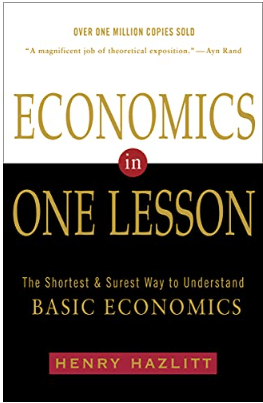
Henry Hazlitt’s popular book ‘Economics in One Lesson’ has been recommended to me many times so I finally took the time to read it. The structure of the book is Hazlitt’s interpretation of economics, the study of how society allocates scarce resources with alternative uses, boiling down to one major fundamental lesson. He presents this lesson in part 1. Part 2 is dedicated to that lesson being applied across various areas of economic interests.
The main takeaway is that economics must not only be evaluated for short term and direct effects, but also for the long term and indirect effects.
Bad Economist vs. Good Economist
Hazlitt makes the distinction between bad economists and good economists. The bad economist ignores this lesson. They focus on the direct and short-term results. The good economist attempts to evaluate all results of economic decisions and policies. The direct and short term as well as the indirect and long term.
Another prominent takeaway is the idea of everything having a trade-off. The inability for us to view solutions without this trade-off mindset is what causes us to overlook the indirect side effects of government’s economic decisions and actions.
The Stone Thrown into a Still Pond analogy
What happens when you throw a stone into a still pond? A bad economist would only look for and evaluate/celebrate/call attention to the splash that the stone made in the water. A good economist would recognize the splash, but also evaluate the ripple effects. Also, the good economist would acknowledge that now the stone sits at the bottom of the pond, most likely providing nothing of value. Gone is the chance, without unnecessary effort, to use it for alternative uses that could have produced value.
The Example
One of the first examples Hazlitt discusses is that of ‘The Broken Window’. In it he describes a scenario where someone throws a brick through the window of a Baker’s shop. A misfortune for the baker, as he now has to replace the window. Though some will reconcile the baker’s misfortune with the Glazier’s (windowmaker) luck. Now, the Glazier will have new business.
This is where Hazlitt points out the flaw in reasoning for those who believe the situation is not as bad since the Glazier now has business. The Baker has to spend money that he would have otherwise used elsewhere. Improvements to his shop, extra pay to his staff, or disposable income for himself. As Hazlitt illustrates, the Baker was actually going to use that money for a new suit. So, in reality the Glazier’s fortune is now the misfortune for both the Baker, who has to spend the money on something he did not want, and the suit Tailor, who will now not get the business of the Baker.
The above scenario also points to a common short-coming in economic thinking. Economics can easily gravitate towards quantitative evaluation. That which can actually be measured and recorded with real numbers rather than any qualitative evaluation. To only look at what the dollar price of replacing the window is, instead of the added stress and disappointment of the Baker. What if the Tailor had had a previous conversation with the Baker and was expecting a suit order to come in. They might have even discussed a specific and unique fabric the Baker wanted. The Tailor, in anticipation, might have ordered that fabric to be in stock in time to deliver the suit. To now know he has lost that business and now incurred unrecoverable costs. Given that the above scenario involved three possible parties. In the event where the window was never broken, both the Baker and the Tailor would have had a positive exchange (the Glazier would be indifferent because no expectation of business was ever perceivable). In the event where the window was broken, the Glazier might experience the exchange as positive, but the Baker surely does not (the Tailor could be either indifferent or like the Baker, also disappointed with their now lack of exchange).
Hazlitt draws upon ‘The Broken Window’ into his next chapter ‘The Blessings of Destruction’. It is an exercise in extending the thinking that ‘The Broken Window’ is actually good for business. But ask yourself this – would everyone start being better off if we constantly just break windows, or other’s property in general? The commonsense answer is no, but he provides examples of how economic thought leaders fall for the broken window fallacy anyways. There are numerous news articles after World War II making the claim that Europe will actually be better off post-war because now all their destroyed factories will be replaced by new “state-of-the-art” factories. This reasoning highlights the lack of thought in qualitative impact. Undermining the immense stressors of war in general and the additional stressors of having to rebuild vast amounts of infrastructure.
A Modern Day Example
Another second order effect is the true price of vandalism. Poverty does not necessarily create criminals, but criminality definitely creates poverty. You can see this today in cities that have spiking crime rates, specifically theft. The ripple effect of increased crime rate is that Mom-n-Pop shops close and larger retailers move out. The ripple effect of businesses shutting down or leaving is the decrease in economic opportunities for the local residents. The ripple effect of lower economic opportunity is the increase to the poverty rate.
My Takeaways
Always strive to be a good economist. Think long-term.
Understand that consequences have consequences. Aks yourself, “What are the indirect consequences of certain actions?”
Take time to think about the qualitative impacts. In evaluating the good fortune of the Glazier, don’t forget about the disappointment of the Baker and the Tailor.
Disclosure: The link provided for the book “Economics in One Lesson” is an affiliate link.
 System Tinker