

It seems the more I learn about the events, cultures, and norms of the past, the more I realize that we lose insight into what we perceive as reality quite often. It is very noticeable if you watch any documentary that depicts a previous time period, especially well before modern times, which shows our ancestors living in a vastly different way than we live today. Obviously, that’s not too hard to argue and seems somewhat silly, but this lost perception of realities is not just specific to times long ago. It can affect you and your present day relationships and interactions in a much larger way than you might care to believe. Can you imagine what your life would be without a cell phone or laptop? Heck, could you imagine actually having to pick up the phone to contact the customer or vendor without the option for email? This is a concept I like to call “lost realities”.
First, to understand how we arrive at a lost reality, we must regress to what reality is and what it is not. Our perception of reality is probably way off from what actual reality truly is. We are starting to learn more about how the brain functions due to recent advancements in the field of neuroscience and we can actually begin to grasp how very little humans can perceive at any given time.* It’s almost like we are functioning in a dark room and using a tiny flash light to try to illuminate it. We only have a focused beam on one small area of the room (this is what we perceive as reality) , and its practically impossible for us to get the overall picture of the room (actual reality) at any given time. So what we process, due to the limitations of the brain, is only a tiny, tiny fraction of what actual reality is at any point in time. This could be hard for us to comprehend at first because we would really like to believe that we have a good grasp on reality, so let’s do an exercise.
Go outside and look at your surrounding environment. Now, figuratively take a snapshot of your surroundings . At first, we think we see so much and will be able to recall information about the environment, but can you answer the following questions and provide an accurate response? Which way was the wind blowing and how strong was it? What was the temperature? Was the sun shining and if so, from where? What noises were you hearing? Did you hear a bird chirp? A cricket creek? What was the atmospheric pressure? Were there any clouds and if so, what way were they moving? These questions could go on and on and on. I know this exercise seems silly, but it does highlight how much information we can be exposed to and how little of that we actually process, even when we are trying to focus.
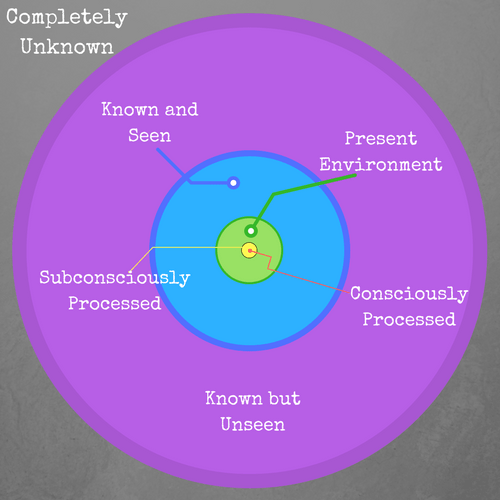
The graphic above tries to illustrate how little we can consciously process at any point in time. There’s a space for things that are “completely unknown” to us which is hard for us to comprehend because we are constantly trying to make sense of the world around us and our brain is using heuristics to make us believe we have. There is the “known but unseen” space which is similar to the “completely unknown” space but at least we have some low-level awareness of it. It also plays to those heuristic tricks on our mind, making us believe we know more or have a better understanding of things that we have an extremely low knowledge of. The “known and seen” space is for events and things that we personally “experience” and therefore have a better understanding than someone who has not. We still are experiencing the heuristic mind tricks that help us create our understanding of these events. This space can be dangerous because our exposure, regardless of the degree of exposure, can make us over-confident when sharing these experiences and our derived beliefs from them with others. This is where we can confuse our account of the events as true and reliable when in reality, it could have been anecdotal. The “present environment” space is what you are exposed to at any given point in time. It is quite literally your current surroundings. This is what your body is primed to interact with at the present moment and what you are able to subconsciously and consciously process. The “subconsciously processed” space highlights how you are currently interacting with and what you are controlling for within your given environment. We tend to forget that our body is constantly trying to regulate and control our internal functions and even sometimes our external functions. We need to regulate our internal body temperature, breathing, digestions, etc. We also sometimes behaviorally act upon our environment in a subconscious way. These are things we do without realizing, like repositioning our bodies if we feel uncomfortable in a certain social interaction. That only leaves us with the tiny red speck in the middle to designate the “consciously processed” space. So getting back to my previous analogy of the tiny flashlight trying to light up a room, its really more like a laser pointer. I’ve seen different figures presented for the estimated processing speed, but we’ll just go with what seems to be the average finding of 125 bits/second. That is micro. It is a tiny tiny fraction of what we are exposed to. Obviously, we can spend more time within our environment to process and retain more, but unfortunately for us, our mortality drastically reduces our ability to consistently spend enough time for each situation.
This knowledge allows us to start identifying ways that this limited processing ability can negatively affect us. For instance, generational gaps provide obstacles and boundaries especially within the realms of communication and understanding. I remember, when at a previous employer, there was a senior member of the group who was very adamant about making phone calls with clients. You could tell that he was not very happy with what he saw from the younger generation and their dependency on email communications. (You could tell he was unhappy because he wore it on his face and swore it in his voice.) To his point though, it was observable to see inquiries to the clients be answered quicker by phone rather than by email, but it demonstrated the concept of lost realities, especially by the younger generation. They were unable to see what truly caused his unpleasant temperament because they did not understand what his reality was rooted in. He started his career amongst a previous and older generation. That generation did not spend their time conducting business through email. Heck, some of their business was conducted by hand written letter and a majority was done by phone. He spent a lot of his client-facing time making phone calls to conduct business and he started to realize the importance of voice-to-voice communication. This helped him to start creating a belief system that was reaffirmed every time he made a phone call.
To further demonstrate how lost realities eventually emerge, lets look at how beliefs, and therefore your realities, are created and reinforced. Your experiences, whether primary or secondhand, are determined through interactions with your prior beliefs and your current environment. Environments are dynamic in nature and are composed of many features. Two of these features are the technological and social innovations of the time. These two features are so robust and nuanced that not everyone always operates within the same environment even within similar proximity to one another. This causes everyone’s individual beliefs, even when looked at in the aggregate, to be truly unique. My full set of beliefs will not fully align with anyone else’s. If you can imagine a Venn diagram, there will definitely be some overlap with others beliefs, but a piece of my “circle of reality”, will always be truly mine and therefore lost on others.
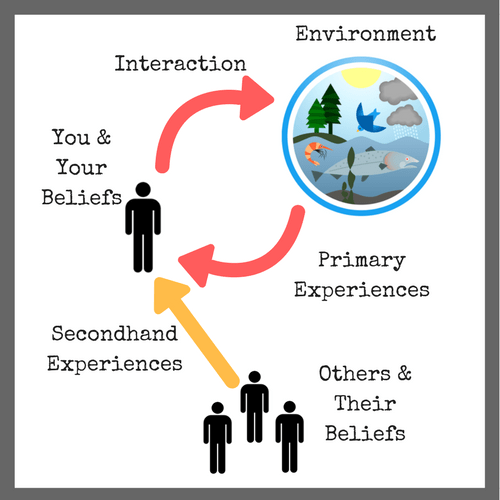
These lost realities can adversely affect our interactions with each other. This can happen because other people’s reality can be lost on us and vice versa. Getting back to something previously mentioned, one of the biggest impacts that these lost realities have on our relationships can be found across generations. We can simplify and break down realities at the macro or micro level. At the micro level, you have the smaller scale realities whether it’s personal or within a smaller social group setting (we won’t focus on the micro level in this article, but could feature it in a future article). At the macro level, we have major cultural differences (again, we won’t focus on major cultural differences in this article, but could feature it in a future article) and generational gaps. An example of a macro reality being lost between two generations, would be millennials not being able to truly comprehend the cultural and political landscapes of say the 1960s and 1970s. However, this works in both directions. I believe this occurs because as we age, we tend to let the environment have less of an impact on our closely held beliefs. We can attribute this to things such as confirmation bias, which is our tendency to interpret, favor, and/or recall information in a manner that confirms our preexisting beliefs or assumptions. The priming effect also plays a role, whereas a belief could act as a stimulus in a way that primes our attention to other stimuli that reinforce that belief. Each new experience that confirms a belief creates a new neural fiber that is wrapped and bounded to the neural connections that help maintain that belief. So, even in the case where the older generation is in the same proximity as the younger generation, the older generation tends to let the environment affect/impress their beliefs less, resulting in a lost reality.
So getting back to the senior member I worked with previously. His neural connection, consisting of many neural fibers, is so strong now, he truly believes phone calls are the superior method to interact with the client when you cannot meet in person. The contradictory actions to his belief that he saw perpetrated by the younger generation upset him, but part of his frustration was also due to his own lost reality. He failed to see that to some degree, and definitely for certain situations, email was the preferred method of communication. In fact, if he was dealing with a business owner from the younger generation, the repeated phone calls could be considered a nuisance by the client and that relationship could become jeopardized.
I believe it’s necessary to designate some space in your mental faculties to become a lost reality detective. When you can detect a situation that is being negatively affected by the possibility of incongruent realities, you have the ability to proactively diffuse a potential conflict that could result in irreparable damage. When you have an understanding that you might not be operating in the same reality as someone else, you can better navigate current and future communications. It helps you avoid overly emotional interactions which allows more rational thought and communication. This should, more often than not, leave the door open for more opportunities. A great book that can help you work on your beliefs is Liminal Thinking by Dave Gray. A subsection of the book description on Amazon reads, “Liminal thinking is a way to create change by understanding, shaping, and reframing beliefs. What beliefs are stopping you right now?” I found this book to be thought provoking and very helpful.
In conclusion, understanding and working towards mitigating the negative effects of lost realities should lead us to better relationships and interactions within our professional and personal lives. Time to find your lost realities!
*Although there is conflicting research and findings (like the findings mentioned here, here, and here) regarding the amount we can consciously process at any given moment, all of the research done to date seems to suggest that we still cannot process anywhere close to the amount of information we are exposed to.
 System Tinker