

As blockchain innovation continues to improve and emerge as a possible solution for practically everything (sarcasm), more and more businesses are trying to understand it and adopt it into their models. So it raises the question, what could a blockchain organizational structure look like? As a note, blockchains adopted by organizations to be contained within that organization (permissioned) will definitely be different from blockchains that are fully open-sourced and available to anyone (permissionless), but some of the features that blockchain technologies offer will be recognizable in both.
The Current Structure
Corporations, and many other organizations, have typically followed a strict hierarchical organizational structure that is usually represented by a triangle (as shown in the image below). The “Bottom” layer has little to no influence within the organization and does not receive much in terms of compensation. The “Tip” layer has the most influence and receives the most in terms of compensation. The “Tip” layer would consist of C-suite employees & Board of Directors. Each layer in between has influence and receives compensation in correspondence to its relative position within the organization.
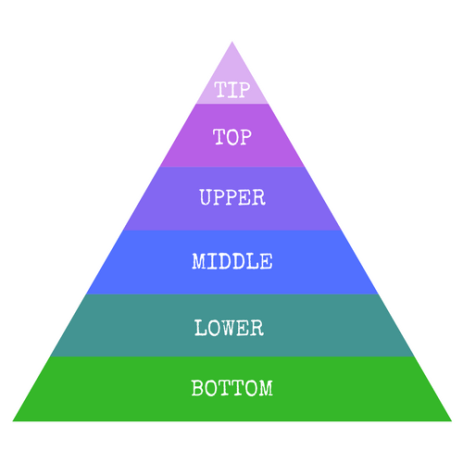
Pyramid scheme jokes aside, this structure emerged for a reason and has allowed corporations to be a dominant institution throughout the 19th to early 21st centuries. Two reasons for this structure include higher regard for experience as a prerequisite for promotion, management roles, and increased responsibilities, as well as the impossibility for a system to adequately capture true value added by contributors. The latter reason in itself contributed to the former. Since there is no way for an organization to capture an individual’s true contributed value, we fall back on a system that lets more tenured employees determine what that contributed value is. Although, there are certainly cases where this system has worked (and it’s worked decently enough to stick around for this long), for the most part, it is a broken system.
The Old Approach
The old approach favored rewarding those who stuck around the longest because we equated their tenure with experience. This experience was supposed to be gained through understanding and applying the tools, processes, and systems of the company, developing relationships with people all throughout the company, as well as knowing and understanding the needs of the customers. There is some truth to the benefits of retaining this type of knowledge and there is great benefit to retaining top talent, but not every individual whose been around the company for ten plus years should be promoted for just that reason alone. There’s actually a possibility that someone’s tenure and promotion schedule is based on their inability to actually contribute any value or provide any type of leadership whatsoever.
This is how that cycle plays out: the individual rides the coattails of coworker/s -> does enough to get by and to provide an alibi (this usually includes some type of scheming/politicking that covers their ass by throwing someone else under the bus or getting in good with a superior who then provides safe harbor) -> this continues to happen until coworkers have enough and decide to leave -> the individual is the last man/woman left standing and leadership rewards them with a promotion for experience, willingness to stick it out, etc. This cycle continues as they move up the ranks and get more and more responsibility and decision-making power. This is highly frustrating to people who observe these particular individuals, the ones they’ve had actual exposure to, who are getting undeserved promotions while they keep getting passed up.
But this is not the only way people rise to power in their chosen field. If they are a smooth talker, they can leverage that skill to interview very well using experiences that are either exaggerated or not theirs at all. The only way to defend against this is by using a referral system in where the job candidate gets to handpick their actual referrals. What stops them from selecting their partners-in-crime at previous employers who will gladly corroborate their experience? Nothing. Those two scenarios probably account for most of the people who gain power albeit their terrible leadership and non-existent value-driving abilities.
What adds insult to injury is that your position within this hierarchical structure helps determine your overall compensation. So anyone who’s risen through the hierarchy by means other than true value contributed, is receiving better compensation than some lower level contributors who are potentially more worthy of better compensation. To those who legitimately try to do the right thing by working hard, being a team player, and looking to help the organization as whole rather than just helping themselves, it seems to be a case of good guys/gals finishing last. But, there is good news and a welcomed change on the horizon! This change comes in the form of blockchain technology.
How Will Blockchain do This?
Blockchain will transform organizations by decentralizing processes and responsibilities that were traditionally centralized within the organization. One of Blockchain’s main feature is the distributed nature of its record keeping which is extremely hard to manipulate or delete. The organization would use decentralized applications (dApps) and smart contracts to create, allocate, and rate work. Individuals’ work would be trackable based on the wallet (node) they work out of. This allows organizations to be run as a meritocracy. Individuals work would be recorded in a distributed ledger across the organization and it would be extremely difficult for someone to dispute or claim their work. The organization could just simply check the blockchain to validate who contributed the work. Blockchain’s protocols and platforms allows individuals to organize in ways that were historically very hard to coordinate for or operate in. This decentralization would allow for decision-making to be crowdsourced as well.
Who Will Lead the Charge?
I believe younger workers and disenfranchised employees will be best candidates for these organizations to form and operate early on because of their desire to be heard and to receive adequate compensation without having to wait for a promotion due to tenure or experience.
When Will the Blockchain Organization Come on to the Scene?
One thing that will be interesting to see is how and when this restructuring will occur. Will present-day corporations be the ones to drive the change? If they do eventually restructure the way I propose, I think it will most likely be in response to new competing organizations that emerge from the blockchain revolution. The “blockchain effect” most likely will occur for organizations heavily involved in the digitized world and that will be sooner rather than later. It initially might have less of an impact in industries and fields that are more physically involved but can eventually work its way in. For example, an organizational restructuring of a construction company might start with a bottom up approach in their design phases and a reputation bank might be used for a foreman’s ability in providing job site safety and mitigating workplace hazard risks. Needless to say, it will definitely have different impacts and implementation timelines across different fields and industries.
Blockchain for Lifestyle Designers
Another trend that might emerge is a large increase in independent contractors (ICs). ICs will work several jobs at once. They will have increased flexibility to work at anytime from anywhere. Whats even more interesting is that instead of just doing individual contribution type work, they will be able to participate in some management responsibilities due to a merit system. This will further increase their ability to influence an organization and be rewarded for the value they contribute. Instead of trading their time for money, they trade their time for the possibility of value creation which is not capped like wages or a salary are.
The Beginning of the “Reputation of Things”
For ICs that do specific tradesman work like an electrician, they will carry their reputation with them across job sites and that reputation will be embedded into the building’s “reputation”. I believe a major feature that will emerge out of blockchain implementation is the concept of reputation since it will be more accessible and more prevalent on ‘things’ rather than just on humans. (I plan on doing a post about the “reputation of things” sometime in the near future)
The Blockchain Effect on Organizational Structure and Compensation/Value Distribution
What could occur is a bottom up approach to determine top down allocation of work. This would be contained in a continuous feedback loop as once the top down allocation of tasks and work is done, it will be scored based off of any number of factors like value contributed, efficiency, etc. As those who were responsible for the top down allocation get scored they can either move up or down in merit ranking. The bottom levels responsible for the work performed are scored as well. They either receive an increase, decrease, or no change in merit ranking. One thing to point out is that this is not a zero sum game. In the scenario where all bottom level users provided work that grew revenue and overall profits, they would all receive merit and compensation increases proportional to their contribution.
There will be this constantly adapting makeup and blend of organizational merit. Tenure alone will not result in an increase to merit. Only if your tenure led to experience that contributes to the overall value you provide. This system doesn’t crown a C-suite to steer the organization, rather the leaders are constantly emerging based on merit. It would be unreasonable to assume that one person rises to the top and provides vision for multiple functions of the organization for an extended period of time. It is much more likely that each function has a grouping of leaders that provide vision within that function as well as contributing to the overall vision of the organization. There would, at any given time, be a hypothetical “CEO” of the organization based on merit, but no guarantee that they stay in that position. It would most likely be a revolving door of leadership without most of the negative effects of actual turnover. I believe the organization would start to flatten, but not fully, and become rounded at the top.
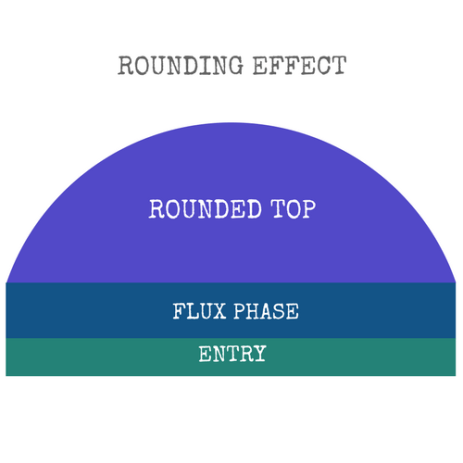
The greatest thing about the rounding effect is that it takes the compensation that was heavily weighted at the “tip” and “top” levels in the traditional hierarchical management structure, and reallocates it amongst everyone in the organization based on their merit. It allows more people in the organization to share the wealth created by the organization. There’s also good reason to believe that an organization would be “healthier” in the sense that by utilizing the wisdom of the crowd for organizational decision-making, you are more likely to act appropriately and increase the probability of making the best possible decision. The different sections of this rounded structure highlight to distinct phases.
The “Entry” phase is where new nodes to the organization would start out. This is where you would need to earn your keep. It could very well be a permissionless blockchain that distributes non-sensitive work that would allow anyone to contribute. This phase would allow you to start earning reputation and start to be compensated, albeit modestly, for the work you contribute.
The “Flux Phase” is where you start to earn more and be recognized more for the contributions you make to the organization. It is where you could start to have more of an impact on decision-making within the organization. You would start to create and allocate work to ‘Entry’ phase workers.
Your abilities to create valuable work would help you graduate into the ‘Rounded Top’ phase. This could potentially be a permissioned blockchain that contains more sensitive information. The individuals operating in the “Rounded Top” phase would have a desirable amount of merit which would be used for more critical decision-making responsibilities. They would also get to share in more of the wealth that the organization generates.
The main reason I believe we will not see a truly flat hierarchy is because, in the end, we still value valuable experience. The more work you perform for an organization should give you more insight into the needs of the organization and the organization’s customers. We will still want a structure that rewards those who are willing to apply those insights in ways that benefit the organization. I believe organizations have always resembled the rounded top underneath their skin, but we have just overlaid the traditional hierarchical structure due to some limitations. Now we have the chance to overcome those limitations.
I believe there will be several different organizational structures that emerge due to blockchain innovation, and I have only proposed one possible way a decentralized organization, or a “blockchain corporation” might look like or function. I am excited to see how it all shakes out and am interested to hear what you have to say regarding this topic. Please leave a comment below to join the conversation. Regardless, blockchain technologies should allow for “leaderless” organizations that operate just as, if not more, effectively as current hierarchical organizations, while sharing the wealth with more of the individuals who contribute to that wealth creation.

