
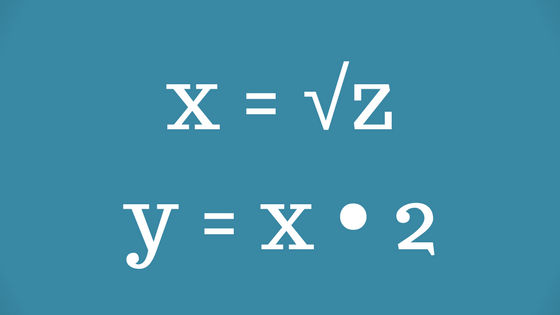
The Stakeholder Formula is a simple calculation that allows you to estimate the appropriate amount of stakeholders necessary to undertake any project or initiative that results in positive change to your organization. It is important to note that this formula only results in an approximation and each scenario requires additional information and considerations. The Stakeholder Formula is:
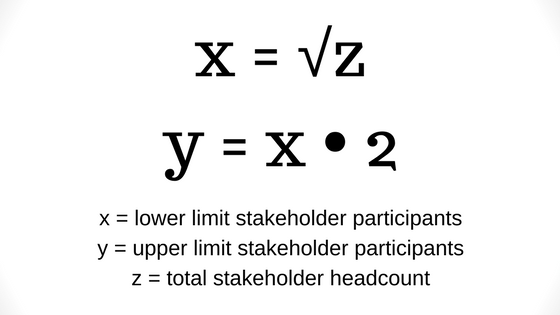 The square root of your organizational unit’s total stakeholder headcount (z) represents the minimum number of people (x) needed to be involved in any process improvement, change management initiative, etc. This results in the lower limit of the range. To get the upper limit(y), take the lower limit, and double it. For example, the total stakeholder headcount identified for a cross-functional process improvement initiative is 400 individuals. The square root of 400 is 20 which represents the lower limit. Double this amount and we get 40 which represents the upper limit. So our range is 20 to 40 stakeholders that will need to be engaged throughout the project to provide feedback, perform testing, run pilots, etc.
So why does this formula result in a range? This is because it simply gives you flexibility, but there are trade-offs. The more stakeholders involved, the more expensive the project will cost, but the better probability that the project will be successful. The closer you are to the lower limit, the less expensive the project will cost, but the lower probability that the project will be successful. You would also really need to choose your participating stakeholders more wisely.
What are organizational units? Organizational units are standard groupings designated within the company. Here are some examples of organizational units for companies:
Functional
These might also be called departments or sometimes business units. They typically consist of a specific function for the organization. For example, there are legal departments, accounting departments, sales departments, etc. The managerial hierarchy is typically contained within the function and associates only report to someone else within their function. A Functional structure creates what some call vertical silos in the organization.
Cross-Functional
Typically referring to two or more functions within an organization, but not the whole organization itself. Processes can span multiple functions or departments within your organization or company. A typical company usually has around five major cross-functional processes. Some common cross-functional processes are quote-to-cash (QTC), procure-to-pay (PTP), or product development. For example, your QTC process might include marketing, sales, implementations/installations, finance, accounting, and billing functions. All of these functions would be included as part of the total stakeholder headcount for your formula. When making a change to your cross-functional processes you also want to identify who all the customers of the processes are and include them as well. This could mean that you are including your actual customers or vendors, or individuals within the organization that are not directly part of the process, but are receiving results from the process.
Organization Wide
This will include obviously every individual within your organization, but this also includes key external stakeholders as well. When you are making a change that affects the organization as a whole, you want to get input from key outsiders. They might be your top customers, board of directors, shareholders, etc.
Smaller Teams/Initiatives
These are typically ad hoc or projects/initiatives that are not cross functional in nature. They might be specific to a function and have little impact across the organization or they could be an initiative outside of the organization’s overall operational objectives. For example, a community outreach program or a young professionals group. We can view these as a scaled-down versions of the cross functional processes. For these you do want to include all active participants, sponsors of the initiatives, individuals who could become future participants, and external individuals who could potentially benefit from the initiatives.
Business of One
This is an entrepreneur who is doing it all on their own or with very few full-time employees. The stakeholder formula still applies here. Entrepreneurs who really are just a business of one typically perform all of the processes and procedures necessary to run their business themselves. The formula is still used for any process improvement initiative, especially ones that affect your current customers or vendors. You would still include all of your customers and vendors in the total stakeholder headcount. The formula for anything that is specific to just the entrepreneur would result in a lower limit of one and an upper limit of two, meaning that some changes would benefit from an outside perspective. That’s exactly where System Tinker can help out. We try to provide enough useful content to help you on your journey to becoming a successful entrepreneur. If you need more strategic advice, you can always reach out to us for our Advisory services.
The Stakeholder formula is a simple calculation you can use to approximate the amount of stakeholders you will need to include to drive any meaningful change within your organization or company. Hope you find it useful!
 System Tinker