
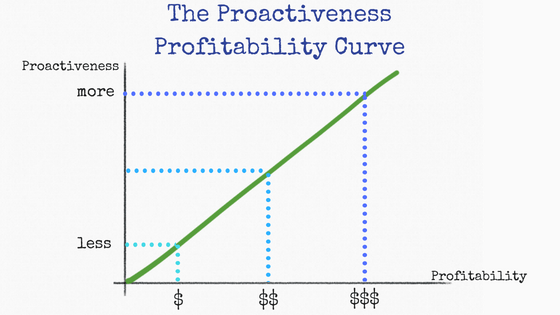
Just like my post Starting with Margin in Mind describes, every major business, corporation, or operation today most likely started out as just a small start-up or operation. You’ve probably heard of numerous success stories with someone starting out in their garage or on their parent’s kitchen table. A primary reason which allowed them to scale was their profitability.
One of the major contributors to profitability is the degree of proactiveness. This is the ability to prepare for, and control for the expected situations that you might face in business. Proactiveness leads to entrepreneurs identifying an opportunity early on that they could capitalize on. Proactiveness leads to entrepreneurs systematically capturing their process to make their operations repeatable and more efficient. Proactiveness leads to entrepreneurs and business leaders identifying potential risks and developing plans to mitigate any negative outcomes were these risks to be realized. All of these play out to your bottom line.
In Bartley Madden’s book Value Creation Thinking, he demonstrates the value in being proactive, especially right after innovation occurs. The business that can not only innovate their product or service offering to bring something valuable to the market, but also to innovate internally to make the process of production as cost-effective and efficient as possible, is poised to capture and retain market share for a longer and more sustainable period of time than businesses who do not. This is how being proactive versus reactive should play out in the competitive phase:
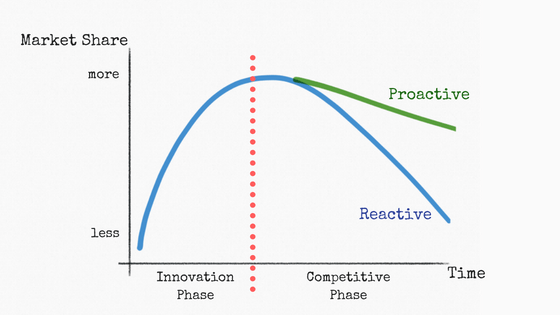
Take for example an entrepreneur who identifies an opportunity to bring something new and innovative to the market. There are some startup costs involved, but she is able to get her product up and running and she has initial success. She decides to look at her costs of production and her processes very early on to identify ways to be leaner and more efficient. She is successful in finding unnecessary costs as well as unnecessary steps in the process. She also solves for some bottlenecks that were occurring in the process. Very early on, she is able to reduce her costs significantly and not only increase her profit, but simultaneously lower her price to squeeze out any would be competitors that would harm her market share. You can see in this pretty straightforward example how being proactive could positively impact your business.
Proactiveness creates more opportunity for revenue while also spearheading any unnecessary costs. This drives profitability. So what are some areas that you can look to be more proactive in?
- Crisis Management – the process by which a business or organization identify, plans, and deals with a sudden emergency situation. This could be caused by natural disaster, new regulation that makes your business obsolete or less needed, or a new competitor that is draining your market share. Be more proactive by knowing your risks and developing plans of action for them.
- Process Improvement – A business process is a series of actions or steps taken in order to achieve your business’s desired results. Process Improvement is the practice of continuously optimizing for your business’s processes. Be more proactive by continuously looking to make your processes better at giving all of its stakeholders their desired results.
- Market/Industry Trends – Know the general direction in which your market or industry is developing or changing. Be at the forefront of this change. Here are some trends to look out for:
- What do your customers or potential customers want now or in the foreseeable future?
- What kind of work are my employees looking for and how should I reward them?
- What are the changes I’m seeing from my vendors and suppliers and how would that impact my business?
- Technology – This is the creation and application of new scientific knowledge for practical purposes or uses. Be proactive by knowing what technologies are being developed that could potentially hurt or help your business.
- Vision & Strategy – You most likely have a vision for your company or yourself. It is essentially where you want to find yourself or your business in the future. Your strategy is your plan of action designed to achieve your vision. Make sure you are periodically updating and aligning your strategy to your vision.
Think about other areas in your business or life that could benefit from being more proactive. Develop a plan for those areas and put it into action right away. Remember, in most situations, it pays to be proactive.
 System Tinker